The Challenge: The Confidentiality Paradox
Top-tier law firms face a critical technology paradox. Generative AI offers unparalleled efficiency in digesting thousands of pages of historical case law. However, leveraging commercial models like ChatGPT, Claude, or Gemini requires transmitting highly sensitive, privileged client data to external, third-party cloud servers.
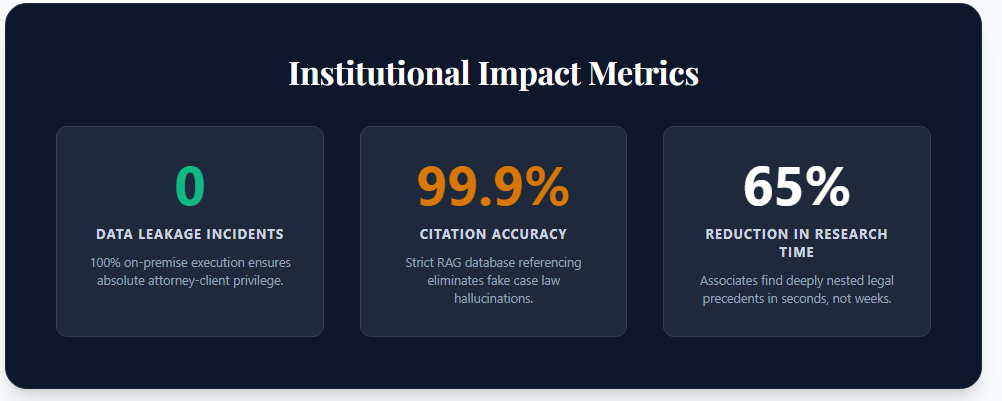
In the legal sector, data privacy and attorney-client privilege are absolute. Uploading proprietary litigation strategies or unredacted discovery documents to a public API is a severe ethical violation. Furthermore, commercial LLMs are notorious for "hallucinating" fake case citations—a catastrophic error that can lead to judicial sanctions and disbarment.
The Mandate: The client required an advanced conversational AI that possessed the vast reasoning capabilities of a modern LLM, but hosted entirely on their own private servers, physically cut off from the outside internet, with a mathematically verifiable zero-hallucination rate.
The Solution: Zero-Leakage Sovereign Architecture
AIdea Solutions rejected the standard API wrapper approach. Instead, we architected a Sovereign Legal Precedent AI from the ground up.
We deployed highly customized, open-source foundational models directly onto the firm's private, on-premise GPU clusters. We then restricted all external internet access. The AI was trained strictly on two verified datasets: a comprehensive database of public historical case law, and the firm's own highly confidential, proprietary historical rulings.
- 🔒Air-Gapped Security: Zero data transmission to external tech giants. Complete compliance with strict client confidentiality.
- ⚖️RAG Verification Layer: A strict Retrieval-Augmented Generation architecture forces the AI to pull exclusively from verified legal texts, eliminating hallucinations.
Beyond Search: Advanced Legal Intelligence
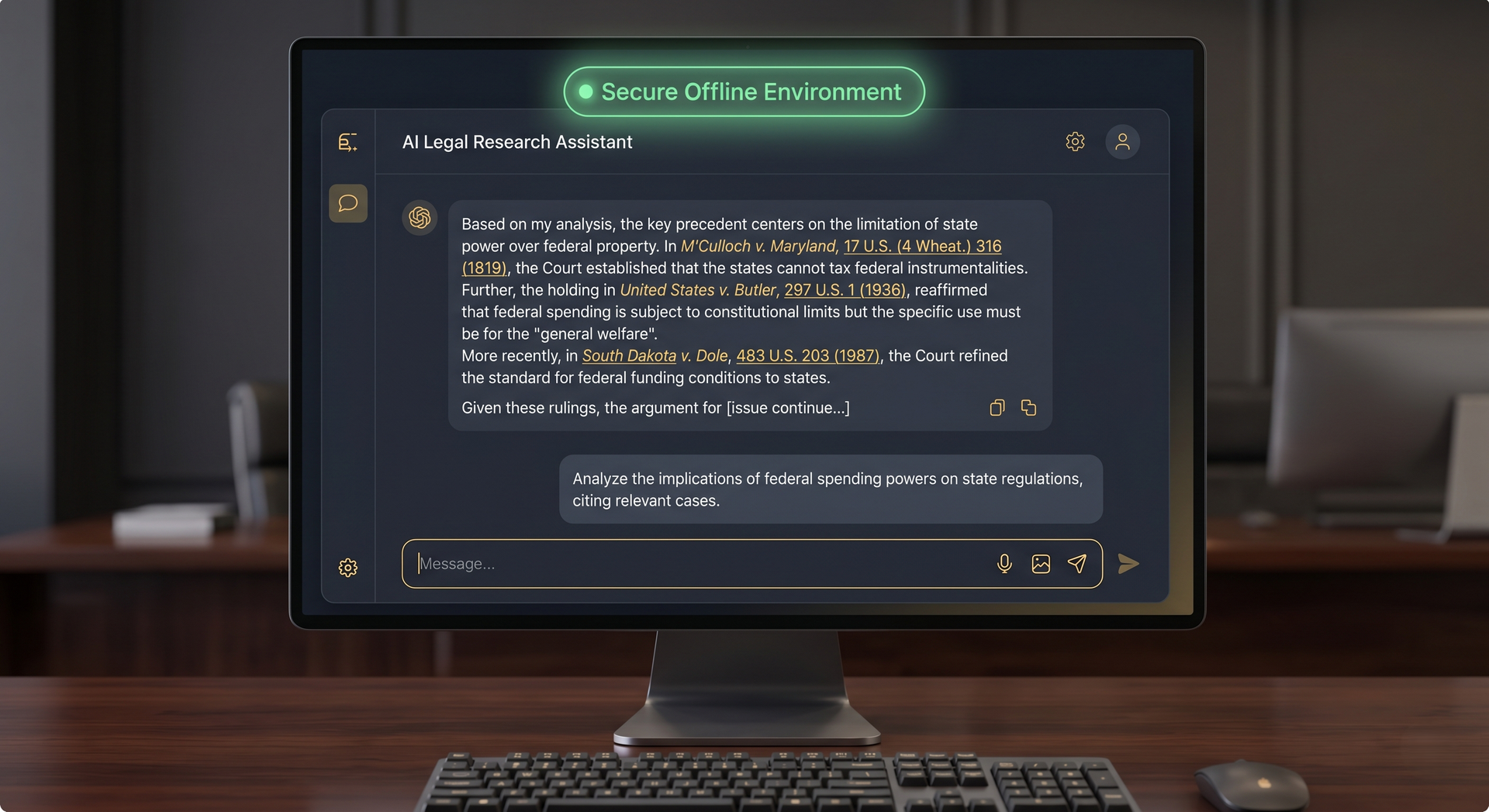
- Hallucination-Free Citation EngineWhen suggesting a legal argument, the bot guarantees absolute accuracy by providing the exact hyperlink, page number, and perfectly formatted Bluebook citation to the historical precedent. If the case does not exist in the private database, the bot mathematically refuses to generate it.
- Semantic Fact-Pattern MatchingLawyers do not search by keywords; they search by scenarios. An attorney can type a complex story (e.g., "Vendor went bankrupt after a hurricane destroyed servers"). The bot semantically understands the context and surfaces historical "Force Majeure" cases with exact fact patterns, even if the word "hurricane" was not explicitly used.
- Automated "Shepardizing" & Good Law VerificationThe AI tracks the chronological chain of precedent. If it cites a 1998 Supreme Court ruling, it automatically runs a background vector search to ensure that ruling has not been overturned, distinguished, or narrowed by a subsequent ruling in 2026. It strictly suggests "good law."
- The "Distinguish" Opposing Precedent EngineAttorneys can securely upload an opposing counsel's brief. The bot reads the opponent's cited cases and instantly scans the historical database to find cases with similar fact patterns that resulted in different rulings, handing the attorney the exact precedents needed to invalidate the opponent's argument.
The Danger of Public LLMs in Law
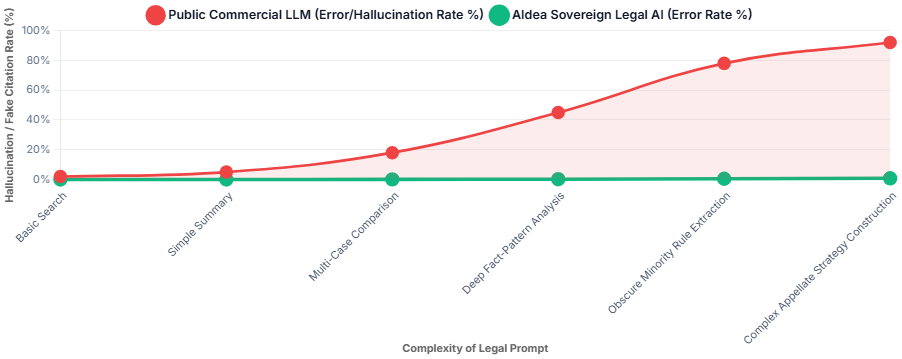
As the complexity of legal queries increases, commercial LLMs drastically increase their hallucination (fake citation) rates. The Sovereign Legal AI utilizes RAG verification to maintain a near-zero error rate regardless of complexity.